

Asbestos continues to be a relevant risk on legacy building projects.
In this first edition of The Brief, we highlight a recent inspection in Oxfordshire where asbestos was identified within loft insulation during a routine pre-refurbishment survey.
We explore:
- What HSE guidance says about pre 2000 buildings
- Where asbestos containing materials (ACMs) are still commonly found
- Why early surveys reduce cost, risk and disruption
- How RJS Waste Management supports safe, compliant site preparation
Identifying Contamination Before Works Began
RJS Waste Management recently carried out a pre-refurbishment asbestos survey at a property in Oxfordshire, where samples of loft insulation were taken as part of standard procedure. Lab analysis confirmed the presence of asbestos fibres, demonstrating how ACMs can still be found in materials that are often assumed to be low risk based on age or appearance.
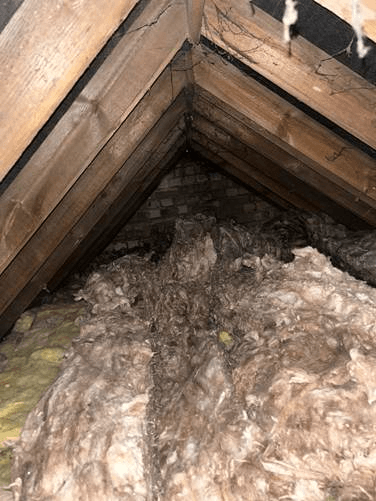
Loft insulation within a roof void where asbestos-containing materials were identified during a survey. Image: RJS Waste Management UK Ltd
What Does HSE Say?
According to the Health and Safety Executive (HSE), an asbestos survey is required for any nondomestic property, or domestic dwelling undergoing refurbishment, if built before the year 2000. Asbestos containing materials (ACMs) were still used in construction right up until the 1999 ban, and may still exist in:
- Insulation (loft, pipe, cavity)
- Cement boarding and soffits
- Textured wall and ceiling finishes
- Roofing felt and floor tiles
Surveys are the only reliable way to identify these materials before they are accidentally disturbed during works.
Failing to identify asbestos containing materials (ACMs) before a project begins can lead to:
• Immediate project stoppages • Emergency removal and remediation costs • Resequencing of trades and disrupted timelines • Regulatory breaches and potential legal exposure • Health and safety risks to on-site teams
By identifying ACMs early, surveys enable informed decision making, accurate budgeting, and efficient scheduling, all essential under CDM 2015. For developers and principal contractors, it’s one of the most effective ways to protect your workforce, your programme, and your client’s trust.
What Happened Next
Following the positive identification of asbestos fibres in the loft insulation, we supported the client by coordinating the next steps:
- Isolated the affected area to prevent accidental disturbance
- Coordinated the safe removal process in accordance with asbestos regulations
- Ensured all waste was transported and disposed of via a licensed waste transfer facility
- Provided documentation for compliance and project records
Because the issue was identified early, the client was able to avoid disruption and move forward with a clear, compliant strategy.
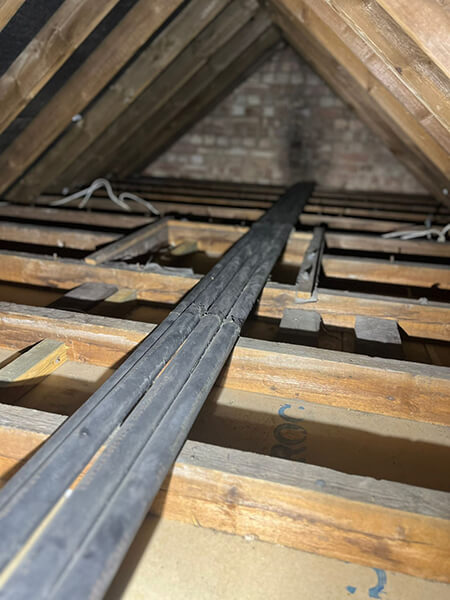
Roof void pictured after asbestos-containing materials were safely and legally removed, with the area cleared and prepared for ongoing refurbishment works. Image: RJS Waste Management UK Ltd
How RJS Waste Management Supports Project Planning
At RJS Waste Management, we work with developers, architects and site managers at the earliest possible stage to support safe, compliant delivery. Our services include:
- BOHS P402 qualified asbestos surveys (Management, Refurbishment and Demolition, Reinspection’s)
- UKAS accredited sampling and lab testing
- Loft insulation and soft strip out preparation
- Hazardous waste clearance and responsible disposal
- Nationwide coverage
📍 Coordinated through a single point of contact, with no guesswork or delay. 👉
Roof void pictured after asbestos-containing materials were safely and legally removed, with the area cleared and prepared for ongoing refurbishment works. Image: RJS Waste Management UK Ltd
📞 Contact Our Regional Teams
Oxford Office (Oxfordshire): 01865 598069 Chichester Head Office (Sussex): 01243 213273 London: 020 7859 4520 Midlands (Stoke on Trent): 01782 956268 🌐
www.rjswastemanagement.co.uk 📧 info@rjswastemanagement.co.uk
✅ Final Word
Whether you are overseeing a retrofit, phased redevelopment, conversion or refurbishment, identifying asbestos before works begin is one of the most effective ways to protect your programme, your people and your budget.
Start smart. Build safer. Stay compliant.